| |
(I) Relevant web information on research project
1.Our
submission to the Internet exhibit:Our work;Backup of our web site
2.Home
page of our school:http://www.lcps.tpc.edu.tw
3.Completion
date of the research project:13th January 2005
4.Name of school:
Lu Chiang Elementary
School, Lu-Chou City, Taipei
County
Address: No. 1 Min Chuan Road, Lu-Chou City,
Taipei County
5.City/County: Lu-Chou
City, Taipei County
6.Name of teachers: Shuhui Chang, Tsai-Chieh Lin, Yunju Chen
7.Name of the
team: Egret force - eleven students in total participated in this research
project.
8.Age of students: 11~12 in six grade
9.E-mail
address for this research project:leader0208@pchome.com.tw
(II) Overview on research project
1.Category of the Internet exhibit in which we participated:“Local leaders”
2.Our community:
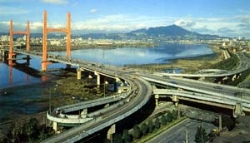
Lu-Chou city is
situated on the west bank of the lower Danshui River; its northeast side faces Shilin
District in Taipei, separated by a river; its
west side connects with Wugu Township and its southeast side is adjacent to Sanchong
City. Its shape is that of a vertical rhombus. The area of the city is 8,321 square
kilometers and, of the 29 townships/cities in Taipei
County, it is only slightly larger
than Yonghe City. Lu-Chou was originally a sandbank formed by
river alluvial deposits with a flat terrain and rich soil; which made it
suitable for farming and residential purposes. However, due to frequent floods in the area,
the pace of its development has been slower. In 1982, its flood problem was alleviated due
to the “Plan for urban construction of Sanchong
and Yonghe”, approved by the central government, together with the completion
of an initial plan for flood prevention in the Taipei region and the Erchong flood release canal. In addition to the
convenient commute to Taipei,
its resettlement population from other regions increased dramatically. And “Lu-Chou
Township” was upgraded to “Lu-Chou City” in 1997.
|
|
|
|
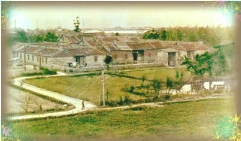
Historical Lu-Chou as a predominantly agricultural society |
Present day Lu-Chou as a commercial and industrial city. |
3.Outline of research project:
|
At the age of
seventeen, a girl gave up her socially privileged life and comfortable
environment to join the war against the Japanese. She crossed over long distances and married into
a family rooted in Taiwan,
where she conquered a language barrier and the pressures of a large family. For the sake of her husband, she traveled to
Mainland China
when she was pregnant to petition for the release and exoneration of her
husband from the 2-28 incident, yet she herself became implicated and was
imprisoned for no reason. In prison, where
she wasted 15 years of her life, she had to bear the sorrow of the death of her
husband.
After her release
from prison, she experienced hardship and discrimination in life, which led her
to establish “World Translation Co., Ltd.” at the age of 50. Once her career achieved a level of success,
she won the respect of her relatives. As
a result, they invited her to preside over the plans of donating their family
home as a historical site. Over the years, she gradually convinced her
relatives to agree on passing their ancestors’ cultural heritage down to future
generations of the nation. This was a significant part of completing her
mission. More importantly, she obtained the 4,000 signatures required to pass
the Cultural Assets Protection Act, which promoted further extension of the
Cultural Assets Protection Act in Taiwan.
Her
name is Hsiu-Feng Yen – an extraordinary woman that steadily stands in the
mighty torrent of history.
Through our
current project, we will reconstruct this piece of history.
|
4.Our Internet environment:
The network in the
school uses fibers of 10MB to connect with Educational Internet Center of
Taipei County. The Internet equipment of
the computers at home uses 56K dial-up modems, as well as ADSL, to connect
online.
5.The problems we
conquered:
(1)Pressure from class
and insufficient time
All of us are
sixth graders from Class 16. Since the
decision in October was made to participate in the competition, we have continuously
devoted our efforts everyday. Since we
are sixth graders our class load is heavier than usual. In addition we have our graduation trip coming
up, a competition filled with fun planned, and after school lessons for many of
our classmates. Thus, it was surprising that we were able to have all of our
classmates present at one time. Sometimes it was quite a headache when the
Internet exhibit team requested us to submit our homework.
Luckily,
we were able to use our lunch hour and self-study period in the mornings to complete
most of the work, thereby solving such difficulties. However, at times when the work could not be
finished, we still had to sacrifice our leisure time to complete our goal. Nevertheless, the tasks were completed! Although it felt like such hard work, we
experienced new things and gained new knowledge during the course of each task work.
Even if we achieved only a little, it
gave us great sense of achievement and we did not feel like it was so hard all
the time.
(2)Difficulties in
recording the broadcast drama
Since we had
never recorded a broadcast drama and understood little about it, it was quite
uncomfortable and awkward to speak when we first started practicing. After practicing
several times and familiarizing ourselves with the drama, we were able to
somewhat grasp the characteristics of the performance. However, the recording equipment in the school was rather basic, so the results of the first
recording were awful and we were very depressed about it.
Luckily we had
Teacher Tsai-Chieh to encourage us and to analyze the problems for us. We continuously learned through practice the
secret of recording a broadcast and finally succeeded after many trials. However, we felt that we could do even better
if we had the chance to practice a few more times.
In fact, Teacher Tsai-Chieh was the one who
worked the hardest throughout the entire process. Although she did not present in our broadcast
drama, she had to train us, give us lessons, help us understand the story of
Grandma Yen and teach us how to use the equipment.
(3) Difficulty in distinguishing
and promoting our activity with other activities in the school
Since
our school is quite big, we already
had many activities on normal days. The
question of how to attract people’s attention to our activity was really a pain
in the neck for us! Furthermore, we
ourselves had three activities to promote, which created a problem of how to
distinguish the characteristics of these three activities.
To solve this, we used three different types of methods to promote
our activities. First, we offered prizes
for a quiz on the broadcast drama to induce interest from the kids in the school. In
addition to the active promotion for this activity in the morning rally, we
specifically put the audio file of the broadcast drama on a web page for the school in case students did not hear the broadcast
clearly. Students could choose what they
wanted to listen, and we encouraged for greater participation on the activity
when we met classmates we know in the school
or their brothers and sisters. Since we
knew that the content of the broadcast drama was better suited for students in the
middle and higher grades, we simplified the story of Grandma Yen to tell it to
the lower grade students during their free time. After telling the story, we would ask them to
draw the part that impressed them a lot. In this way, we would not leave out the group
in the lower grades. Subsequently, we displayed
the pictures we made in the courtyard so that teachers, students, and parents
in the school could get to know the characters in the story as they were taking
a rest or walking.
|
We
were glad that these three activities attracted different types of community
participation. Thus, people from within
or outside of the school, as well as
people on the move or people at rest, could interact with the subject we were
promoting through the method of their choice.
|
(4)Poor communication
skills
We
thought that preparing promotional materials for the activity was all we had to
do. We discovered though that poor
communication of many details would cause delays in the entire project. For example, sometimes portions of the work
couldn’t be completed because people had different understandings of the same
words during our promotions. There were also times when we didn’t properly
confirm the loan of equipment with teachers in various departments. This caused
last minute chaos and unexpected situations.
When
an unexpected situation occurred, we were all willing to cooperate with each
other to take on an extra share of the work, thereby solving the problems
accordingly. We learned that we would rather take the
painstaking steps of confirmation and reconfirmation rather than face any
unexpected situations resulting from our negligence.
6.Things
we learned:
We study at Lu Chiang Elementary School. Most of us were born and have grown up in Lu-Chou.
Yet we shamefully know nothing about the
historical characters and events that took place in this area. We only recently learned that we had a strong
and tender heroine among us after our interview with Madam Yen. She bravely fought in the war for her country
and people, but when she talked about her husband, Mr. Yubang Lee, she also
showed her tenderness with charm.
We thought this type of person only existed as a proper noun in text
books…distant from our own lives.
However, we truly and really interviewed a woman like this by listening
to every word she said. We saw the solemnity
and righteousness in which she talked about historical facts. We also saw her determination in not giving
up on her desire to protect of Chinese culture. We were very lucky because we could personally
interact with someone of such historical significance without using a CD and
interacting with a computer. We also did
not need a text book to tell us about the people, events and things that took
place on this land upon which we live. We could witness for ourselves on this land through
our own efforts. Such a feeling of
satisfaction to participate in history was far beyond the satisfaction of
reading a social studies textbook.
(III) Key elements of the research project
1.How did you combine
the subject that you used for this “Internet exhibit in Taiwan” with nine years
of consistent education and standard classes in school?
|
By participating in this activity, we noticed everyone’s
development. The development was not
only in the students, but even the teachers gained a lot of valuable
experience. This was our first time taking
part in the completion of an Internet exhibition and after a series of activities,
the teachers saw the excitement in the students’ eyes, asking: “Can we do more
activities?” From this, we knew that the
students had really devoted their heart and strength. Of course, there were times of despair and
frustration, but we conquered them all because we knew that the fruit gained
from overcoming the frustration and difficulties were surely sweeter.
Through a series of activities, we learned some different skills and
gained valuable experiences:
|
I. Things learned:
1.For the teachers:
(1)Better understanding of community
topics: Most of the teaching in the past
was limited to knowledge found in text books. Although consciousness of community education
started to rise, the method of education was still limited to conveying
knowledge through text books. Therefore,
community education had not truly been introduced into the community, and
people’s feeling to their hometown was not that deep. Through this project, we practically explored
and searched for every topic in the community. As a result, we gained greater
knowledge about the community.
(2)Enhancement of the teachers’
professional ability: Such a project
involved extensive attributes and the capabilities needed are even more
diversified. The scope contained not
only the methods of research and Internet application, but also the compilation,
studying and application of knowledge from each field. The teachers could show their own skills to each
other during the activities; and indiscernibly making up for the aspects lacking
in the other teachers’ professional knowledge through continuous discussion and
study. Moreover, this was a cultivation
of leadership, a skill involving the ability to lead students in long term research
while keeping them continuously motivated. Experiencing this sense could only be encountered
during the activities.
2.For the students:
(1)Different learning experience: The experience of participating in the Internet
exhibit was a totally different way to learn from studying text books. The nine years of consistent education emphasized
a lot on demonstrating the ability to put things together. The students learned each type of experiences
through a series of activities in this research project. For example, through the process of preparing
and planning for the trip and promotion practice, they learned to cooperate with
others, work with others, research with others, discuss with others, etc. The kids would learn that demonstrating and the
holding an event needed a long time to plan and prepare, and that more careful
planning and thinking in advance could make for a smoother process. For example, a small piece of note paper let
the kids clearly understand whether the promotion was progressing smoothly or
not, where there were defects, or what classes were not promoted. Although it was only a tiny piece of paper,
the effect was enormous when valuable records and memories often disappeared
instantly without such piece of note paper. To the kids, these experiences were totally
different with learning from text books.
II. Combined with nine
years of consistent education:
1.Scope of language study: The entire project included information collecting, reading of
relevant books, writing in journals on what has been learned, the arrangement of
the content on the website, the design of the quiz format, the actual interviews
of local people, and the promotion within
and outside of the school, etc. These
items enhanced the student’s ability to listen, speak, read and write.
2.Artistic and cultural study: Through the design and
making of the study sheets, together with the artistic design of the web page to
promote within the school, the
students cultivated their ability to create and appreciate beauty, as well as
enhance their artistic knowledge.
3.Study of nature and life sciences: Since the commencement of the
project, the students cultivated their abilities to observe, question, plan,
conclude, judge, work in teams and get along with each other in harmony,
communicate with people and cooperate, as well as criticize and create. The students also learned how to use
scientific resources as a tool for research to explore problems, search and
compile resources and information, which allowed students to enjoy the fun of
study through exploration and independent thinking.
4.Study of composite activity: Through the project, the students experienced, practiced, and directly
felt the influence and significance of a historical person in Taiwan. Their participation in the project allowed
students to express and think about their experiences freely. They could also use their own ways to express
the meaning of the project. They were
also able to examine and think about cultural preservation and conflict in
reality.
5.Six major topics
(1) Informational education: During
the research project, the students researched, processed, analyzed, demonstrated
and applied information using various skills, while the information was used as
a tool to expand study and communication.
(2) Environmental education: We combined the experience of environmental activity
into the learning process through the project, which made the students study
our community more closely. The project
cultivated students’ ability to handle problems in their hometown, and students
were able to have deeper feelings of belonging, recognition, and participation in
the community.
III. Standard classes
in the school and community classroom:
1. Standard classes in the school: The nine years of
consistent education gives the school a 20% right to structure flexible classes.
In addition, a research project for a
community web page such as this is an activity that is worth participating in
for all teachers and students in the school.
During the project, we saw the passionate
energy exuded by the kids to participate. This involved learning something that was closely
tied to an area in which they lived and was different from other lessons taught
through text books (e.g., English). This
type of class was worthwhile for us to promote, and it makes the students’ life
more diversified and richer.
2.Community classroom: “When there is a classroom in the community,
one can study everywhere.” This belief revealed a very important idea over
recent years. The words “when there was
classroom in the community” is different from the studies in our country’s
education in the past, which was mostly limited to knowing the place that we
live in or the delivery of knowledge on culture, special treats, etc. in our hometown.
The community classroom, on the other
hand, expects kids to walk out of the room and not base everything on books. Instead, it makes every corner in the
community full of study through actual experience, visits, etc. However, the community classroom emphasized
one thing –one must be able to feel and care for his hometown in addition to
knowing it. This is mainly because we
all exist in certain periods of history and we will all be a part of the historical
story of our hometown in the future; with our own strength, the culture of our hometown
might be further developed. This will
allow more local residents to know their own hometown better; which is also a
very important mission for our participation in the Internet exhibit.
2.What information
technologies did you use to complete your research project for the Internet
exhibit?
3.
What methods did we
use to play the role of “ambassador” via the Internet or to gain personal and
group contact?
(1)Broadcasting
over the entire school.
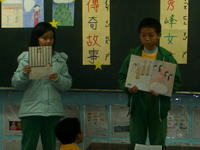
We used our lunch hour to broadcast the story of Grandma Yen using
the broadcasting system throughout the school.
We also used prizes for quizzes on the
broadcast drama to get all the students in the school
to know more about Grandma Yen.
(2)Place
information of broadcast drama on web page for the school.
We
asked Teacher Weng, as the chief of information of the school, to put the audio
file of our broadcast on a web page for the school, as well as to publish the
name list of the prizes for the quizzes on the web page, so the kids access the
relevant information online all the time.
(3)Tell
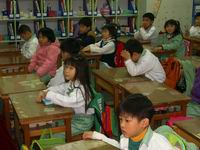
the story of Grandma Yen at the classrooms of first and second graders
Our last activity was telling the story in the classrooms of lower
grades. Through our beautiful paintings
and touching stories, students in the first and second grade got to know
Grandma Yen better.
4.What influence and
impact did the research project have on you?
(1) The influence on the
students in this school
The thoroughness of our promotion attempted to leave no stone
unturned. We then spread our message though visual, audio, and verbal channels.
We discovered from this project that many kids became more familiar with this period
of history. What moved us more was that
some of them even searched for information via the Internet or books/newspaper.
Through research, we discovered that all the students
knew about the Lu-Chou Lee Family House and some of them had even visited the
place. However, the understanding by
everyone of the Lu-Chou Lee Family House was basically based on historical
interests, but the understanding of the people was limited only to members within
the Lee Family. Thus, we decided to make
everyone take a new look at the history of the Lu-Chou Lee Family House from a different
perspective.
For students in the lower grades, we combined pictures with story
telling to allow for an initial understanding from students in the lower grades
of Madam Yen. For the middle and higher
grades, we used broadcast drama combined with giving prizes for quizzes to
attract their attention to this project and to enhance their understanding of Madam
Yen. Furthermore, we provided students with
the web address so that if they were interested, they could learn more about
the life of Madam Yen via the web site.
(2) The influence on the
local community
The spreading of this chapter of history was the biggest goal of our
project because Madam Yen stood before us as a living historical legend. While we didn’t actually experience the
historical time period, we felt that we could still add our vivid mark in that
period of painful history. Therefore, we really wanted to preserve some of the
tracks of history by developing the project through the Internet exhibit.
Madam Yen has contributed a lot to Lu-Chou. This was not only because she kept the Lee
family’s old house here, but it was also due to the important history she has
left here through the story of her life. However, people in Lu-Chou nowadays
are almost unfamiliar with her life. We want
to use this opportunity to place our records onto the website, so everyone that
visits the site can get to know this story. As for our project in the exhibit, we designed
a static exhibit targeting people all over the Lu-Chou region. They can view the information about Madam Yen
when they visit our school. Through the students in the school, we hope more of them will talk about this
very important historical figure in Lu-Chou to their parents.
5.Explanation for copyright
and quotations included on the web page.
All the words and content of the website were derived through personal
interviews that were arranged and edited by the “Egret Force”. The person interviewed has been notified of
the parts taken from the questionnaires and interviews as content for our project.
We have obtained their consent to be
quoted on the subject’s web page. With regards
to the relevant documents and books, we also got consent from the author (Madam
Hsiu-Feng Yen) to include a link in a specific page on the website to list
information including the name of the book, the author, the publisher, the date
of publication and the page of reference, so the author’s right can be
protected, as well as in respect of the author’s copyright. With regards to photographs, in addition to
the ones that we took ourselves, the author has agreed for us to use her old
photos and pictures for the story.
6.Discovery, lessons learned
and surprises
(1)We could also do it!
During the project, many of us thought about giving up as we faced challenges
of varying degrees and the pressure of time. After all, we are only sixth grade kids. We could have used the excuse of inexperience
or could have just given up. I don’t think
the teachers would blame us too much, right? But when such thoughts came up and we looked
at our teammates who were still working hard, the thought of giving up just
went away. In fact, we should say that
we did not have the courage to let people know about our disappointing
behavior. We always thought that we
would not last through the moment of seeing the result, but we did it! We never knew about the capacity and ability
within ourselves, but in fact we really wanted to tell people: “Ha! We could
also do it!”
(2) Taking up
responsibility is an act of maturity
We often thought that we were very mature and adults always treated
us as kids. By participating in this Internet
exhibit, we wanted to let them know that we could do something very well. Nevertheless, we usually caused delays in the project
throughout the process of participation because we did not pay enough
attention. The teachers always told us
that taking up responsibility is an act of maturity, and we think that we now know
what maturity is and how an adult should behave due to this study. Maybe we are still immature, but we now know in
what ways we are immature. After this
experience, we believe that we will do better next time!
"Amount of contribution to the “Sixth Internet
exhibit among schools in Taiwan”:
|
Participant |
Description of Work |
Percentage |
|
Members of “Egret Force” |
|
1. Determined the names and planned for the subject
2. Team meeting
3. Completion of progress reports for the
research
4. Collected and arranged information
5. Determined of the people to interview
6. Finalized the draft of the interviews
7. Prepared for the promotion (story design and
study sheets)
8. Produced broadcast drama
9. Executed the promotion, interviews,
questionnaires and story telling
10. Made
cards of appreciation
11. Photography,
videography and voice recording of the process of the activity
12. Recorded and analyzed the content of the interviews
and questionnaires
13. Arranged and filed various information
14. Journal
keeping of the things learned from the various activities
15. Made
the website
|
|
50%
|
|
Instructing
teachers |
|
1. Drafted and modified the direction of the
research topic
2. Assisted with registration
3. Analyzed and instructed on procedures of the
activity
4. Contacted the relevant departments and
persons to be interviewed/promoted
5. Edited and instructed on the promotion documents,
interview documents, debate documents, questionnaires and story
6. Instructed on the division of
responsibilities and works
7. Various administrative procedures
8. Taught the relevant professional knowledge
9. Photography, videography and voice recording
10. Recorded study sheets for each activity
11. Instructed, checked and modified the web
pages on the subject
12. Guided and assisted in computer technology
13. Led everyone to the place of interview
14. Informational equipment and technical support
|
|
25% |
|
Madam Hsiu-Feng Yen |
Accepted
the interview and provided information |
15% |
|
Teacher
Mei-Hui Wang |
Interpreted
Lu-Chou Lee Family House and accepted an interview |
|
Taipei Lu-Chou Lee Family House
Historic Preservation
|
Provided
information on Lu-Chou Lee Family House
|
|
Teacher Mei-Hui Chiang and Su-Chuan Wu from Lu Chiang
Elementary
School |
Assisted
and instructed on the activity of painting a story of Madam Hsiu-Feng Yen |
10% |
|
Teacher in charge of each grade in Lu Chiang
Elementary School |
Assisted
in the completion of quizzes for the broadcast drama |
|
Chief Li-Shu Weng |
Administrative
and technical support |
|